
ALERT Breaking Alert
Breaking · Washington, D.C. · Nov. 25, 2026
We summarize. You read the outlet. Source: Brendan Carr on X · short original summary · full reporting at the source
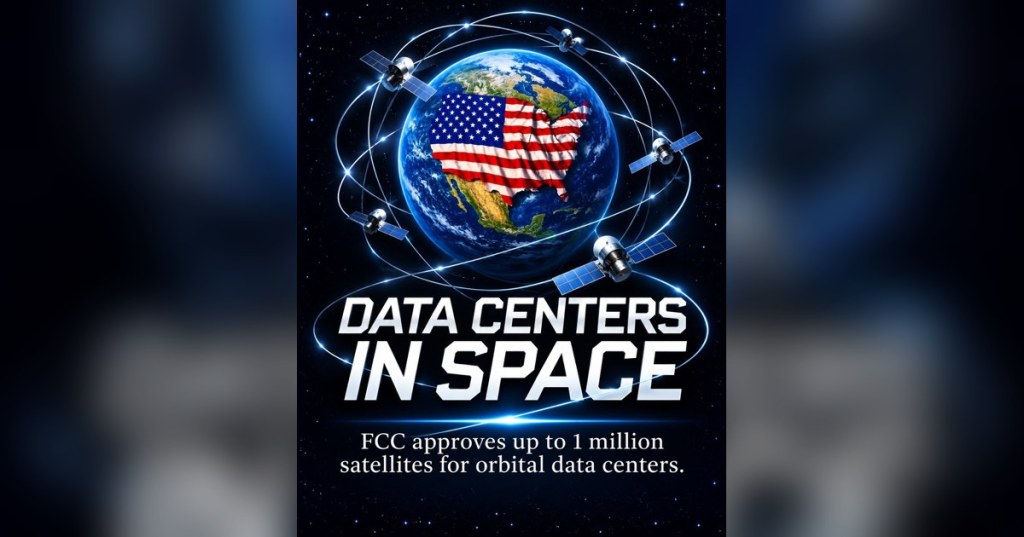
FCC Chairman Brendan Carr said Wednesday that the agency approved SpaceX’s request for 1 million satellites, which he described as orbital compute modules, to create data centers in space. In a post on X, Carr called the action a “historic first” and said the Starmind constellation and competitor systems “will use solar power to extend America’s lead in Super Intelligence.”
The Federal Communications Commission’s Space Bureau confirmed the decision the same day in an official order and news release. The Bureau granted, in part and with conditions, SpaceX’s application to deploy and operate the SpaceX Orbital Data Center System, also called Starmind, a constellation of up to 1 million non-geostationary satellites in low-Earth orbit. The news release called it the first authorization in U.S. history for a constellation of data centers in space.
The radio license is narrower than a blanket go-ahead to switch on a million computers in orbit. The order authorizes radiofrequency communications for backup and emergency telemetry, tracking, and command. The FCC said Starmind will rely on optical links for its primary communications, with Ka-band radio links in the 18.8-19.3 GHz downlink and 28.6-29.1 GHz uplink bands as a backup if those optical links fail.
Under the order, SpaceX must have one authorized space station in its assigned orbit and operating by Nov. 25, 2033; 10 percent of the maximum authorized stations, or 100,000, by Nov. 25, 2035; 50 percent by Nov. 25, 2038; and the remaining stations needed to complete the authorized constellation by Nov. 25, 2040. The license term is 15 years and begins when SpaceX certifies that the first Starmind satellite is in orbit and operating under the authorization.
In the FCC news release, Carr said, “America is leading the world into the era of super intelligence.” He said the grant was “the first time ever” the FCC had authorized deployment of 1 million orbital compute modules, and that “SpaceX and the many competitors working on their own orbital data centers are meeting the moment.” The agency said it is continuing to review additional orbital data center proposals.
Kuiper Systems LLC, Amazon’s satellite unit also known as Amazon Leo, Viasat Inc., and the American Astronomical Society filed petitions to deny the application. The Space Bureau denied those petitions. The FCC said the system “operates consistent with the FCC’s orbital debris rules.” It declined to add extra conditions for optical astronomy, citing SpaceX’s commitment to coordinate with the National Science Foundation, and said some environmental and astronomy concerns were outside its authority.
What is known, and what is alleged
Confirmed. On Nov. 25, 2026, the FCC Space Bureau granted in part, with conditions, SpaceX’s application (ICFS File No. SAT-LOA-20260108-00016, call sign S00798) for the Starmind constellation of up to 1 million orbital data-center satellites. The radio authorization covers backup and emergency telemetry, tracking, and command. Primary communications are to use optical links. Deployment milestones and the 15-year license term are set out in the order. Petitions to deny from Kuiper Systems LLC (Amazon Leo), Viasat, and the American Astronomical Society were denied. The FCC said it is still reviewing other orbital data-center proposals.
Claimed or unproven. The approval does not mean 1 million satellites are already being launched, or that all of them will be. Fox Business, in coverage that also drew on Reuters, noted it is unclear whether SpaceX will put 1 million satellites in space, that about 17,000 satellites are in orbit today, and that operators sometimes seek approval for more satellites than they later deploy. Those reports said SpaceX previously sought approval for 42,000 Starlink satellites and that the network now has just over 11,000 in space.
SpaceX has told the FCC that by using near-constant solar power, the satellites would achieve “transformative cost and energy efficiency” and reduce the environmental impact of terrestrial data centers. Those are the company’s claims, not findings of the FCC order. The agency’s “super intelligence” language and its reference to a Kardashev II civilization are promotional framing, not a scientific conclusion.
The American Astronomical Society said it was “disheartened and dismayed” by the decision and argued that a million larger, brighter objects would harm optical, infrared, and radio astronomy, pollute the night sky, and raise launch, re-entry, and collision risks. The FCC said SpaceX’s debris plan is consistent with its rules, found SpaceX’s pledge to coordinate with the National Science Foundation sufficient for optical astronomy concerns, and treated some environmental and heat-related issues as outside its authority. Astrophysicist Adam Becker, quoted by the Associated Press, called the plan “a fantasy” and said, “It’s not going to happen.” That is an opinion, not a finding of fact.
Carr’s X post said competitor constellations will also use solar power to extend America’s lead. This order approves SpaceX’s Starmind system. The FCC said separately that it is still reviewing additional orbital data-center proposals.
You decide what to trust.
Sources
- Brendan Carr on X (post), Nov. 25, 2026
- FCC news release: FCC Authorizes 1 Million Satellites for Data Centers in Space (Nov. 25, 2026)
- FCC Memorandum Opinion and Order and Authorization, DA 26-1273 (adopted and released Nov. 25, 2026)
- FCC order PDF, DA 26-1273 (milestones, grant conditions, and petition denials)
- The Hill: FCC approves Elon Musk’s SpaceX plan to launch up to 1 million data centers into space (Nov. 25, 2026)
- Fox Business: FCC clears SpaceX for 1 million satellites to extend America’s lead in superintelligence (Nov. 25, 2026)
- NewsNation / Associated Press: FCC says SpaceX can deploy 1 million satellites for data centers in space. Scientists are skeptical (Nov. 25, 2026)
- American Astronomical Society statement on the FCC approval of SpaceX’s orbital data center system (Nov. 25, 2026)

